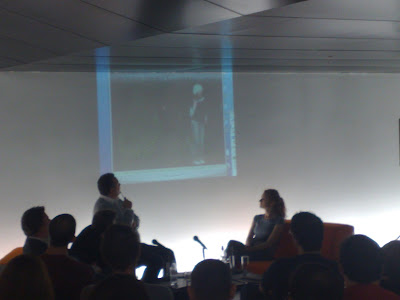
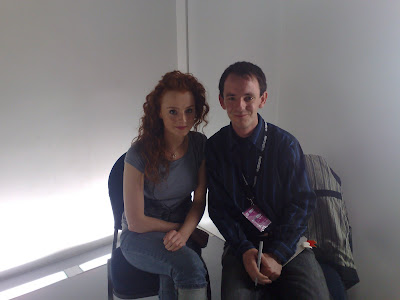
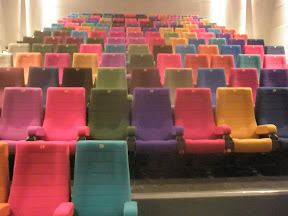
Smithfield's Lighthouse Cinema is a great place to watch a film. Particularly enjoyable and appreciated is their selection which has gathered its own audience and fanbase. It's a lovely space to have a pre-film coffee and chat in, a feature sadly lacking from places like the Savoy, Screen and Cineworld. Their colourful seats are comfy.
We're there to see a preview of Unrelated, the first film of writer/director Joanna Hogg. There's a Q&A with Joanna afterwards and given the fact that this is her debut and has won the FIPRESCI international critic's award at the 2007 London Film Festival, there's a good chance it's worth going to see.
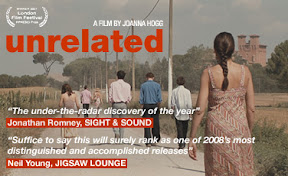
Introducing the film, Neil Connolly from Lighthouse called it "a remarkable debut. While it's very, very British it's also unlike any contemporary British film" while Joanna herself said "this is a film that has encouraged discussion. One of the pleasures of being a film maker is hearing the feedback directly". The critics have been hailing it as "discovery of the year", "refreshing and unusual" and "truly impressive" and the film was hailed by Jonathan Romney in the BFI's Sight & Sound as "the under-the-radar discovery of the year."
I have a healthy respect for film makers, especially given my involvement with the 4 Day Movie project. I'm fascinated not only by the story but the method of communicating, the message the film portrays and the techniques used to do so. I'd read little about the film beforehand to be able to judge it fairly. The basic story:
When fortysomething Anna turns up - sans husband - at the summer home of an old friend, she finds herself reminded of a life she has not lived. Everything she is discovering now, she has arrived at too late.
Usually on the periphery of events, she believes she has found a second chance, mostly keeping the company of the younger folks present - inevitably, and especially with handsome late-teen Oakley, tensions arise.
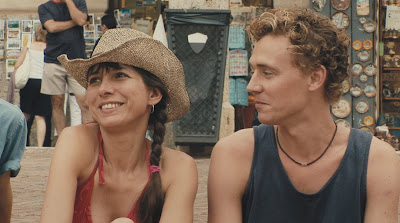
After watching the film, I'm hesitant in sharing any more of the story, other than strongly recommending you give it a go. My advice is based on a few things - firstly, I liked it, as apparently did most of the 100 people in the cinema last night. Secondly, it will make you think not only about the subject matter but about the people you know in a similar situation and thirdly because of the way it's made.
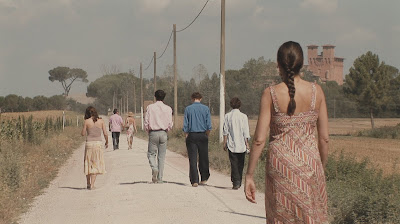
It's a very "
real" film without claiming to be, or forcing its faux reality on you. You'll probably know people like this. You know they exist in their world and that yes, they probably would react this way. While nothing very unexpected happens, events or conversations that seem minor and mundane are suddenly epic, tense and sometimes quite scary. Less is more here. You can't help expecting other things to happen, eavesdropping on conversations and speculating at what you'd do in the same scenario. This is the film's power, why it's different.
The only
"British" element were the cast, whose lack of previous film experience worked superbly to give the film a real sense of authenticity. It was the lead actress, Kathryn Worth's first role. They worked well together, this mix of parents (the "olds") and their teenage children (the "young") - rival camps in a situation that seems remarkably realistic, avoiding what could have been a grotesque "brits abroad" potboiler, as an
Observer critic put it.
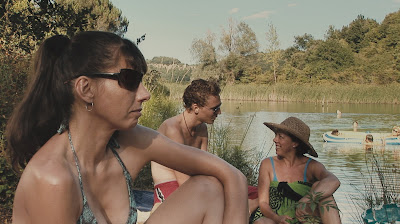
It's a film of remarkable contrast, with unusual devices used to highlight differences. The old people need a lot of sleep. The young people are loud, energetic and move, whereas the parents are still, moving only when necessary. Every youthful experience is accompanied by noise and colour while there's a real sense of quietness about situations requiring maturity.
In fact, it's the silences in the film - where dialogue is not needed, would seem artificial or intrusive and so is not included - that makes it so different and gives it that sense of watching something very real, very personal unfold. It's a very brave move by the director and one of the first we talk about afterwards.
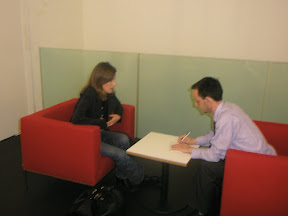
"After school I started as a photographer. I'd always been passionate about film but loved the power of photos and images. I was lucky enough to work in a studio which I had the use of at weekends. Equally, London at the time was a great place to see experimental film - there were cinemas like the Gate at Notting Hill where non mainstream films could be enjoyed.
The film is not so much autobiographical as slanted from a personal perspective at a particular time in my life. I never experienced a holiday like this. However I did feel that if I didn't do it now that I wouldn't have gotten a chance again. It did feel like an act of courage. I'd had ideas over the years but didn't want to put those out into a public arena.
I've worked on a lot of TV - including Eastenders and Casualty - but feel that my passion was on hold during that time. I've always been interested in character and sroty and I feel film is the best place I can show that. TV wasn't me. This is what I want to do. This is what I enjoy."
In a
recent interview with the BBC she states
"I was developing ideas but they wouldn't come to fruition, not because I couldn't raise money for them but more because I didn't quite have the courage to see the projects through," she states. "I couldn't get to the point where I was confident enough to express my own voice, in a way. That's come to me in my 40s, and there's nothing wrong with starting to make feature films at this point of my life, when I feel much clearer about what I want to do."
In fact, as Mary Rose Doorly who was facilitating the Q&A session discovered, the film was made with comparatively very little money.
"It was a small crew and an independent production. Not having anyone breathing down our necks gave us a real sense of freedom. People invested amounts from £2,000 to £5,000 and more to a bigger pool of money, which ultimately meant the majority of the say was with me. I'd much prefer to stay independent, to retain that influence.
"We spent 7 weeks in Tuscany, a place I was familiar with - it seemed to have chosen me. It was more enjoyable for the cast than for me as they were on holiday - it certainly contributed to the realism of their roles. Most of them have theatre or small film backgrounds, so a film like this can be quite difficult, being almost the antithesis of the control and structures in place for theatre production."
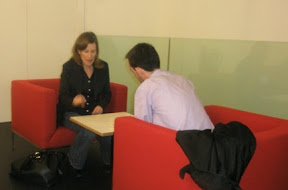
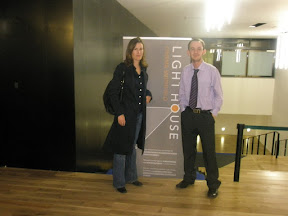
Indeed, as Mary Rose commented, it was lovely to spend 100 minutes in sunny and scenic Tuscany rather than dank and dreary Dublin. As I asked the final, predictable question before the equally predictable photo, I almost knew the answer before she said it.
What advice do you have for young film makers, for people with an idea who want to film it?
Just do it. I feel it's unfortunate for me I didn't do it until now but there's nothing to replace just getting on with recording something. The chances will come.
I owe a massive thanks to Joanna for her time and to Mary Rose Doorly and other reviewers for the words, to Neil and Marietta from Lighthouse for allowing me to indulge my inquisitiveness and wander around with camera in hand. Thank you. I'll be back soon :o)
Unrelated -
website here - opens in Lighthouse on September 19. It's a movie to appreciate. I hope you do.